For internationally mobile families, the fear is real and it surfaces without warning. A posting changes. A contract ends. A family decision requires a sudden move. And in the middle of all that upheaval sits a question that can feel overwhelming: what happens to my child’s education?
If your child is enrolled in a school that follows a nationally specific curriculum – one that is only recognised, or only examined, within a particular country – an unexpected departure can mean lost credits, wasted academic years, and the painful process of starting over in an entirely different system.
The answer to this risk is a portable international qualification. And understanding what makes a qualification genuinely portable – as opposed to merely internationally marketed – is one of the most important things an internationally mobile parent can do.
What Makes a Qualification Truly Portable?
A portable qualification is one that is recognised, understood, and accepted by universities and schools in multiple countries – not because those countries have a diplomatic agreement to accept it, but because the examining body behind it has built a global reputation for academic rigour and consistency.
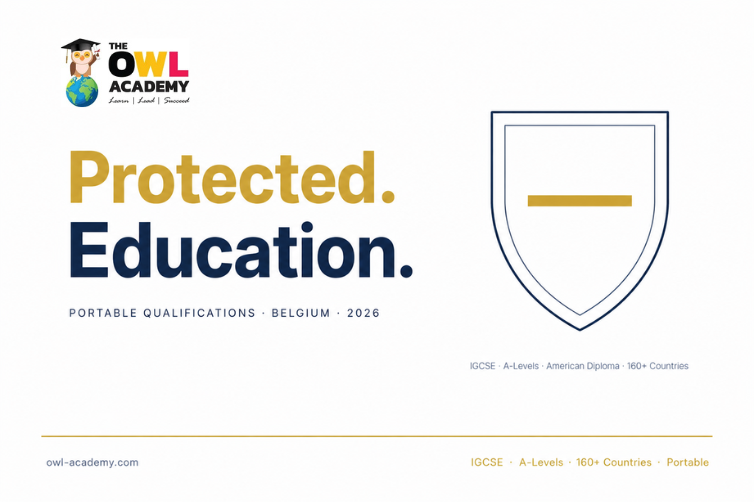
There are several qualifications that meet this standard. Two of the most widely recognised for secondary-level students are A-Levels (examined through Pearson Edexcel and Oxford AQA) and the American High School Diploma with Advanced Placement courses.
- A-Levels are accepted by universities in the United Kingdom, the United States – including Ivy League institutions – Europe, Australia, Canada, Singapore, and beyond. They are examined by Pearson Edexcel and Oxford AQA, examining bodies with a presence in over 100 countries.
- The American High School Diploma with AP courses is accepted by most universities worldwide. Strong AP examination scores may also earn students advanced placement or course credit at universities in the United States and at many international institutions.
- The IGCSE, taken at ages 14 to 16 as the foundation for A-Level study, is recognised in over 160 countries and provides the academic foundation from which students can continue their education in a new country with minimal disruption.
The Risk of a Non-Portable Curriculum
Not all curricula travel equally well. A student following a nationally specific programme – designed primarily for domestic university entry in one country – may find that a sudden relocation creates significant academic disruption. Credits that cannot be transferred. Subjects that are not offered at the new school. Examinations that cannot be sat from abroad.
For families who know they may be in Belgium for a fixed period, or who cannot predict exactly how long they will stay, choosing a nationally specific curriculum is a risk that is worth understanding clearly before enrolment – not after.
The IGCSE as a Foundation That Travels
For students aged 14 to 16, the IGCSE is one of the most robust portable qualifications available. Examined by Pearson Edexcel and Oxford AQA, it is structured to be sat by students in international school settings anywhere in the world. The syllabus is the same whether a student sits papers in Antwerp, Singapore, Dubai, or London.
This means that if a family leaves Belgium mid-IGCSE, the student’s progress is not necessarily lost. With the right school in the next location – and a good international school in almost any major city will accept an IGCSE student mid-programme – the student can continue their studies and sit their examinations on schedule.
A-Levels: The Gold Standard for International Portability at Advanced Level
At ages 16 to 18, A-Levels represent the most widely portable advanced qualification available to secondary school students. The reputation of Pearson Edexcel and Oxford AQA A-Levels is such that universities in virtually every country where competitive undergraduate education exists will recognise and evaluate them.
For a family that leaves Belgium mid-way through a student’s A-Level programme, continuity is possible. Many countries have international schools offering A-Level programmes, and the syllabus – the specific content and assessment structure of each A-Level subject – is consistent across examining centres globally. A student studying A-Level Economics in Antwerp is working to the same specification as a student studying the same subject in Dubai or Cape Town.
The American Diploma: Credit-Based Flexibility
The American High School Diploma’s credit-based structure offers a different kind of portability. Rather than building towards a single set of final examinations at the end of the programme, students accumulate credits course by course. This means that if a student leaves Belgium mid-programme, the credits they have already earned are a quantifiable record of their progress – one that many schools operating on the American curriculum in other countries can receive and build upon.
For families whose next destination is likely to be the United States, or another country with a strong American curriculum international school presence, this credit-based continuity is a genuinely valuable form of protection against disruption.
Questions to Ask Your School Before Enrolment
Before enrolling your child in any international school in Belgium, it is worth asking directly about curriculum portability:
- If we have to leave Belgium before my child completes the programme, what will they have to show for their studies so far?
- In which countries is this curriculum most easily continued if we relocate?
- How does the school handle mid-year departures and can they provide documentation that supports enrolment elsewhere?
- Are the examinations your child will sit available at centres in other countries?
A school with genuine experience of internationally mobile families will have clear, confident answers to all of these questions.
Final Thoughts
No family plans to leave Belgium unexpectedly. But the families who have chosen a portable international qualification are the ones who, when circumstances change, find that their child’s education continues with the least possible disruption.
The choice of curriculum is not just an academic decision – for internationally mobile families, it is a form of insurance. And like the best insurance, it is most valuable precisely when you hope you will never need it.