Most parents visit a school, look at the facilities, speak to a friendly admissions adviser, and make a decision based largely on gut feeling. That gut feeling is not worthless — but it is rarely sufficient on its own.
Choosing the right international school in Antwerp is one of the most consequential decisions a family will make. The curriculum your child studies, the qualifications they earn, and the kind of academic and personal support they receive during their school years will shape their university options, their career trajectory, and their confidence for years beyond graduation.
Before you sign an enrolment contract, make sure you have honest, clear answers to these ten questions.
1. Which curriculum does the school follow — and where does it lead?
This is the most important question, and it is the one that most parents ask last. The curriculum determines not just what your child will study day to day, but which universities they can apply to, which qualifications they will graduate with, and how much disruption a future relocation will cause.
Ask specifically: does the school follow the British curriculum (leading to IGCSE and A-Levels), the American curriculum (leading to a High School Diploma with AP courses), the International Baccalaureate, or something else? Which examining bodies administer the qualifications? Are those qualifications recognised in the countries where you might realistically end up living next? At Owl Academy, students follow either the British curriculum — leading to Pearson Edexcel and Oxford AQA IGCSEs and A-Levels — or the American High School Diploma with Advanced Placement courses. Both are internationally recognised pathways with clear university destinations.
2. How small are the classes — and what does that actually mean in practice?
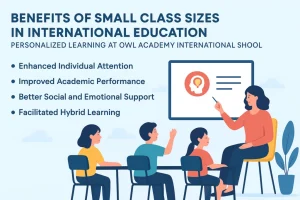
Many schools advertise small class sizes as a selling point. Push for the actual numbers — not the average, but the maximum. Ask to see a typical timetable and understand how many students a teacher is responsible for across their week.
Small classes only deliver their benefits — more individual attention, faster identification of gaps, more personalised pacing — when they are genuinely small. A class of 25 at an international school is not meaningfully different from a state school classroom.
3. Who are the teachers — and what are their qualifications?
Subject specialist teachers and generalist teachers are not the same thing, and the difference matters enormously at secondary level. Ask whether secondary teachers are specialists in their own disciplines — not teachers covering whatever subject needs covering that year.
Also ask about teacher turnover. International schools in expat-heavy cities sometimes struggle to retain experienced staff, because teachers themselves are mobile. A school with high teacher turnover has a structural problem that directly affects the consistency of your child’s education.
4. What does the school’s examination track record look like?
Past examination results are not a guarantee of future performance — but they are the most objective evidence available about how well a school prepares students academically. Ask for IGCSE and A-Level results by subject, not just averages. Ask what proportion of students achieve the grades required for entry to competitive universities.
If a school is unwilling or unable to provide this information, that itself tells you something.
5. How does the school handle students who are struggling — and students who are excelling?
Both ends of the ability spectrum deserve specific attention. Ask how the school identifies students who are falling behind — is it through formal monitoring systems, or does it depend on an individual teacher noticing? And ask how the school challenges students who are ahead — are there enrichment programmes, extension tasks, or pathways into more advanced material?
A school that only talks about supporting the middle of the class is not thinking carefully enough about the full range of learners it serves.
6. What university preparation does the school offer?
For secondary-age students, university preparation is not something that begins in the final year — it begins with subject choices at IGCSE and continues through every stage of A-Level or diploma study. Ask what structured guidance the school provides on UCAS applications, personal statements, admissions test preparation, and interview coaching for students targeting competitive programmes.
If the answer is vague — ‘we offer support when students need it’ — press for specifics. University application guidance should be a defined, structured programme, not an ad hoc response to individual requests. At Owl Academy, university preparation is built into the A-Level and American diploma programmes from Grade 11 onwards — covering UCAS applications, personal statement writing, admissions test preparation, and interview coaching as a structured part of the academic experience.
7. How does the school support students who are new arrivals — or who are not native English speakers?
For families relocating from non-English-speaking countries, this question is critical. Ask specifically whether the school has a structured English as an Additional Language (EAL) programme, how students are assessed on arrival, and what support is provided while a student is developing English fluency.
Even for native English speakers, ask how the school supports new students socially — are there formal buddy systems, structured integration activities, or pastoral staff specifically responsible for new arrivals?
8. What happens if we have to leave Belgium unexpectedly?
This question matters enormously for internationally mobile families and is almost never asked at school visits. Ask what qualifications your child will hold if they leave mid-programme. Ask whether those qualifications are recognisable and continuable at international schools in other countries. Ask what documentation the school provides on departure to support enrolment elsewhere.
A school that serves internationally mobile families will have clear, confident answers. A school that has not thought about this has not genuinely considered the needs of its student population. At Owl Academy, both the British and American curriculum pathways are designed with internationally mobile families in mind — producing qualifications that are recognised in over 160 countries and can be continued at international schools worldwide.
9. What do the fees actually include — and what costs extra?
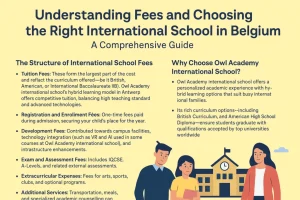
International school fees vary significantly, and the headline annual tuition figure is rarely the full picture. Ask specifically what the registration fee covers, whether it is refundable, and what the payment terms are. Ask what is included in the tuition fee — materials, learning resources, academic counselling — and what is charged additionally, such as examination entry fees, extracurricular activities, or university application support.
Unexpected additional costs are one of the most common sources of frustration for families in their first year at a new international school. At Owl Academy, fees are published transparently — including the annual tuition fee, the non-refundable registration fee, and clear guidance on what each covers.
10. Can we speak to parents whose children are already at the school?
No admissions brochure or school visit will give you the same quality of information as an honest conversation with a parent who has been through the experience. Ask the school to put you in touch with current parents — ideally parents of children in the same age group as yours, and ideally families who arrived as new expats rather than those who have been in Belgium for many years.
The questions those parents answer — and the ones they volunteer without being asked — will tell you more about the reality of the school than anything else on this list.
Final Thoughts
Choosing an international school in Antwerp should never be rushed, and it should never be based on proximity, facilities, or a polished marketing presentation alone. The school your child attends will shape their academic outcomes, their social development, their university options, and their confidence for years to come. At Owl Academy International School in Antwerp, every family is encouraged to ask exactly these questions — because we believe the right school earns enrolment through honesty, not through a polished presentation.
Ask the hard questions. Push for specific, honest answers. And trust a school that welcomes your scrutiny over one that deflects it. If you are considering Owl Academy International School for your child, we welcome every one of the questions above — and we will answer each of them directly.