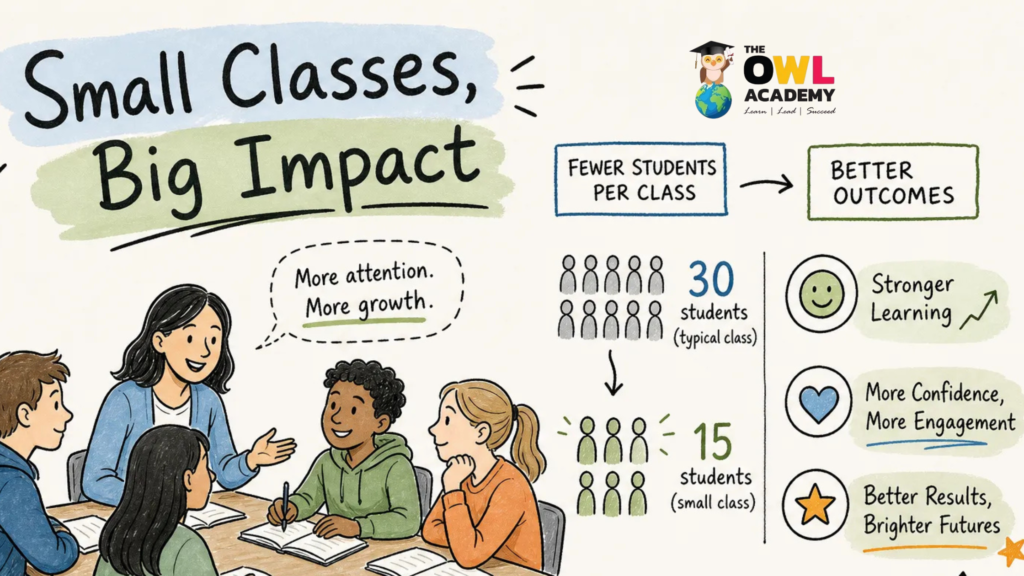
Many parents assume the relationship between class size and educational quality is linear: fewer students means a better education, period. That assumption has shaped school marketing in Belgium and across Europe for decades. The problem is that the research doesn’t actually support that clean story, at least not for secondary students. When it comes to small class sizes in secondary school, the evidence is messier, more conditional, and far more interesting than the brochure version suggests.
OWL Academy in Antwerp has built its secondary model around intentionally small cohorts. That structural commitment is worth examining in the context of what the data actually shows, not as a sales argument, but because understanding the evidence changes how you evaluate the decision. This article is about that evidence.
The thesis is specific: small class sizes do matter at secondary level, but the benefits are concentrated at certain thresholds, apply most strongly to certain outcomes, and affect certain students more than others. Knowing which is which is the difference between making a well-informed school choice and paying a premium based on a feeling.
Why the research on secondary class sizes is more complicated than you think
The Tennessee STAR study is the most widely cited evidence for small-class benefits, and it is genuinely strong research. It randomly assigned students to small classes of 15 to 17 pupils or regular classes of 22 to 25, and the results were clear: smaller classes produced significant gains in reading and mathematics. The problem for anyone applying this to secondary schooling is that those gains appeared in kindergarten through third grade. By the time students moved into their teenage years, the academic advantages from the original reduction had largely evaporated. Parents quoting STAR as evidence for secondary schooling are working from the wrong chapter of the same book.
This is a calibration issue, not a reason to dismiss the study entirely. STAR tells us something important: early class-size reduction works, and its effects can persist into the middle years of schooling. What it doesn’t tell us is that the same intervention applied at secondary level produces the same outcome. The follow-up data from STAR showed no statistically significant results by grade 9, and any remaining advantages by grade 10 were meaningful but not significant in the strict statistical sense.
The UK’s major class-size research programme, the CSPAR study, reached a similarly sobering conclusion. The benefits it identified in reception year and the first two years of school diminished by Year 3, and no positive impact on attainment was identified beyond that point. The Education Endowment Foundation’s systematic review, one of the most rigorous in education policy, rates reduced class size as delivering roughly two months of additional progress per year for secondary students at very high cost: over £30,000 per year per class of 25. That is a significant resource commitment for a modest return.
Where international evidence complicates the picture
The picture is mixed rather than empty. Swedish experimental research has shown measurable improvements in mathematics and language from reduced secondary class sizes, though effect sizes varied considerably by context and implementation. Some English data shows a correlation between smaller classes and better GCSE science results, though this is often confounded by schools assigning more able pupils to larger sets, which skews the analysis.
The full literature consistently points to an effect at secondary level that is real but fragile: it depends heavily on whether teachers actually change how they teach when the class gets smaller. A school that reduces its class size but delivers exactly the same instruction as before won’t see the gains the research predicts.
The thresholds where class size impact on learning becomes real
Across multiple research syntheses, one number keeps appearing with uncomfortable consistency: 15. Meaningful academic gains at secondary level emerge when classes drop to 15 pupils or fewer, particularly when students spend more than 100 hours in that setting. Above 20 students, most studies find the effect on attainment is negligible. This threshold is far more demanding than most parents realize when they hear a school describe itself as having “small classes.”
What “small” actually means in research terms
A school advertising smaller classes with 22 to 25 students per room is not operating in the range where the research predicts reliable attainment gains. The EEF is explicit on this point: modest reductions, moving from 30 to 25 students, produce modest results, and those results cost a significant amount of money to sustain. The gains only become consistent when the reduction is substantial enough to change the actual dynamic between teacher and student. Moving from 30 to 15 is a categorically different decision than moving from 30 to 25, and the outcomes reflect that difference.
The research also shows that not all secondary students benefit equally from this reduction. Disadvantaged students and lower-attaining pupils see the most reliable academic gains from smaller classes at secondary level. For high-attaining students, the attainment impact is less clear-cut. This matters for how parents frame their evaluation: if exam results are the only benchmark, the evidence is selective in who it applies to. Factor in the full picture of outcomes, and the argument for optimal class size at secondary level becomes considerably broader and more robust.
The benefits that go beyond exam results
Smaller secondary classes increase active participation significantly. Students ask more questions, initiate more contact with teachers, and spend less time passively off-task. This is not an anecdotal finding; it appears consistently across multiple studies, including those run by the EEF. The mechanism is straightforward: a teacher with 15 students can track who is struggling, who is disengaged, and who needs a different explanation in a way that is practically impossible with 28 students in the same hour.
Evidence on behavior
Behavior data reinforces this pattern. In larger classes, teachers spend a measurable portion of lesson time on discipline and compliance management. In smaller classes, that time shifts to teaching. A 2016 study by Dee and West examining U.S. middle-school students found that students in reduced classes were significantly less likely to be disruptive or passively off-task. The reduction in clique-forming behavior was also statistically significant: 19% of students in reduced classes exhibited exclusionary behavior compared to 26% in non-reduced classes.
For parents, this translates into something concrete: in a genuinely small class, your teenager is less likely to coast, less likely to hide in the crowd, and more likely to be known as an individual.
Evidence on wellbeing
The wellbeing data is where the evidence becomes particularly compelling for secondary students. Smaller classes consistently produce better wellbeing outcomes: lower anxiety, a stronger sense of belonging, and closer relationships with both teachers and peers. Research published in the British Educational Research Journal (Blatchford et al.) found that reducing class size by 10 students improved wellbeing outcomes related to the classroom environment by up to 0.07 standard deviations across wellbeing measures including perceived support and belonging. Students in smaller classes specifically report reduced learning anxiety and a stronger sense of security when engaging in lessons.
These are not peripheral outcomes; for teenagers navigating the social and academic pressures of secondary school, the environment is part of the education. At OWL Academy Antwerp, operating at this deliberately reduced scale means that teachers build a detailed picture of each student’s learning profile within the first weeks of term, a direct structural consequence of class sizes that sit within the research-supported threshold rather than approaching it from a distance.
Pupil-teacher ratio vs. class size: why Belgian parents often confuse the two
Belgium’s secondary pupil-teacher ratio sits at approximately 9:1, one of the lowest in Europe, according to OECD Education at a Glance data (2023). The Netherlands runs at around 17:1 and the UK at roughly 15 to 16:1. At first glance, this sounds like Belgian secondary students are already in an exceptionally well-resourced environment, and the logical conclusion is that class sizes must be small by default. That conclusion is wrong, and understanding why matters for any parent evaluating schools.
The pupil-teacher ratio is calculated by dividing total full-time equivalent students by total full-time equivalent teachers across a school or system. In secondary education, multiple teachers cover multiple subjects for the same cohort, which compresses the ratio significantly without telling you anything about how many students are sitting in a given classroom at any one moment. A school with a 9:1 ratio still routinely runs classes of 24 to 28 students, because specialist teachers, support staff, part-time roles, and subject specialists are all folded into the ratio calculation.
The metric that predicts the outcomes described in the research is actual class size, not the ratio. When you visit a school in Belgium, the question worth asking is not “what is your pupil-teacher ratio?” but “how many students are in a standard Year 10 lesson?” Those two questions have different answers at most schools, and only the second one speaks to the evidence.
What to look for when choosing a secondary school in Belgium
When evaluating a school’s genuine commitment to small class sizes in secondary school, a few practical questions cut through the marketing quickly. What is the maximum number of students in a single class, by year group? Does the school differentiate its teaching approach based on the smaller environment, or does it replicate large-school pedagogy at a smaller scale? How are students tracked individually, and what is the actual process when one falls behind? These are not confrontational questions; any school that has genuinely built its model around small cohorts will have specific, practiced answers to all three.
OWL Academy Antwerp operates at a scale that sits within the research-supported threshold for secondary class sizes. Its curriculum is the British national curriculum from the elementary years through to A-Levels, delivered through Pearson/Edexcel and Oxford/AQA — not Cambridge International Examinations (CIE). IGCSE and A-Levels are taught through the same Pearson/Edexcel and Oxford/AQA route, and for students on an American track, the school offers Advanced Placement (AP) subjects from the College Board; OWL Academy is a member of Cognia. These pathways are delivered by subject-specialist teachers who know each student’s academic profile in detail. That knowledge is not incidental to the school’s model; it is the premise the model is built on.
For expat families in Antwerp who need curriculum continuity and recognized international qualifications, and for Belgian families targeting UK or US university admissions, the combination of structured pathways and a class-size philosophy grounded in the evidence base is worth examining carefully. Larger institutions sometimes advertise small classes without operating at the threshold where those claims carry research weight; the distinction is worth pressing during any school visit.
The matching question is simpler than it sounds: what does your child actually need? If your teenager is a confident, self-directed learner with strong existing attainment, the academic gains from small secondary classes are real but not dramatic. The engagement, wellbeing, and teacher-relationship benefits may still be decisive depending on temperament and your family’s priorities. If your child tends to disengage in crowds, experiences anxiety in academic settings, or needs consistent individual feedback to progress, the research is considerably more specific: the class-size threshold matters, and finding a school that operates genuinely below 20 students per class is worth prioritizing over campus facilities or league-table rankings.
What the evidence actually demands of parents
The research on secondary class sizes is not a simple endorsement of smaller is better. It is a conditional argument: the benefits are real and specific, but most reliable when class sizes drop below 15, when teaching approaches actually change to match the environment, and when you account for outcomes beyond exam scores. That is a more demanding standard than most school marketing acknowledges, and most parents making choices in Belgium have never been given the numbers to evaluate it properly.
Belgium’s low pupil-teacher ratio is a statistical artifact of how teachers are counted across subjects and roles, not a guarantee of small classroom environments. The actual class size at the school your child attends is what the research speaks to, and it is a question worth asking directly during any school visit. A favorable ratio and a genuinely small class are not the same thing, and confusing the two is a costly mistake.
For families who have worked through this evidence and want to see how a school’s model holds up against it, OWL Academy Belgium offers a direct opportunity to ask these questions in context. Small class sizes in secondary school represent a structural decision with measurable consequences for engagement, wellbeing, and individual progress. Whether that model fits your child is worth examining with the same rigor you’d apply to any significant educational investment.
Contact OWL Academy to arrange a consultation and see the model in practice.