To enroll your child in an international school in Belgium, the most important thing to understand first is that the system isn’t centralized. Every family is essentially piecing together the same puzzle from scratch: which curriculum fits, which documents to gather, when to apply, and who to actually call. The process does follow a clear sequence, choose a curriculum, gather documents, check intake windows, complete municipal registration, book school visits, and apply formally, and working through it in that order makes everything significantly more manageable.
This guide walks you through everything you need to know to register your child at an international school in Belgium, whether you’re relocating to Antwerp, Brussels, or anywhere in Flanders. We’ll cover curriculum choice, the documents checklist, intake windows, municipal registration, the application process itself, and what fees actually look like once you account for all the extras. Schools like OWL Academy in Antwerp offer a free initial consultation, so you don’t have to work through all of this alone.
Start with curriculum choice, because everything else depends on it.
Choosing the Right Curriculum Before You Enroll in an International School in Belgium
The curriculum your child follows shapes which universities they can realistically target, so this decision needs to happen before you fill in a single form. Belgium’s international schools typically offer two main pathways: British (IGCSE and A-Levels) and American (High School Diploma with Advanced Placement subjects). Each pathway has distinct entry requirements, and getting this right early prevents a disruptive mid-stream switch later.
The differences matter in practice. IGCSE and A-Levels are the standard route for UK university admission, including Russell Group and Oxbridge applications. The American track, built around Advanced Placement (AP) subjects from the College Board combined with strong SAT scores, is the pathway for US college admissions.
One important note: IGCSEs alone are not a university entry qualification. They’re a prerequisite for A-Level study, not a direct ticket to a bachelor’s degree program.
OWL Academy in Antwerp offers both British and American pathways under one roof, which is a meaningful advantage for families who aren’t certain whether their long-term destination is the UK, the US, or somewhere else entirely. OWL delivers its British curriculum — IGCSE and A-Levels — through Pearson/Edexcel and Oxford/AQA, rather than Cambridge International Examinations (CIE), and its American track through College Board Advanced Placement subjects. The school is a member of Cognia. That dual-curriculum model provides genuine flexibility without requiring a move to Brussels.
If your child is currently mid-stream in a non-English or non-aligned curriculum, international schools typically assess prior learning through academic records and, in some cases, a placement assessment. Many schools also offer bridging support and EAL programs for students who need additional help accessing their new program, ask each school about their specific provision.
Enrollment Documents for International Schools in Belgium
Most international schools in Belgium share a common core document list. Having everything ready before your first enquiry speeds up every subsequent step, because missing even one item can delay an application by weeks, particularly when translations are involved. Assemble both a physical and a digital copy of the following before you reach out to any school.
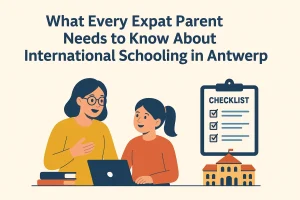
The standard checklist every admissions office will ask for includes:
- Child’s passport and birth certificate (copies)
- Academic transcripts and school reports for the last 2–3 years
- Current-year progress reports (essential for mid-year transfers)
- Immunization and vaccination records
- A reference letter or completed teacher reference form from the current school
- Proof of residence in Belgium, or documentation showing a pending visa or application
Documents not in English, French, or Dutch need to be officially translated, and in some cases notarized. Translation timelines vary, allow several days to several weeks depending on translator availability and whether notarization is required, and factor that buffer into your timeline well before any application deadline.
For mid-year transfers specifically, schools also require a transfer certificate confirming the child is leaving their previous school in good standing. Some schools request a withdrawal form or letter directly from the previous institution.
Secondary-age applicants may need to show language proficiency, particularly for entry into Year 11 or other advanced secondary programs, where a B2 English level is often expected. If your child’s primary instruction language hasn’t been English, check with each school about their language assessment process before submitting a formal application.
Intake Windows and When to Apply for International School Enrollment in Belgium
Timing is the most underestimated part of this entire process. International schools in Belgium don’t operate on a shared calendar, and the difference between applying in October and applying in March can determine whether your child secures a place or lands on a waiting list for the following year.
For September 2026 entry, many year groups at well-established private schools in Antwerp and Brussels are already full or near-full. Private schools typically open applications from September of the prior year, with the most competitive year groups (Years 5, 9 in particular) filling as early as January or February. The Brussels European Schools run a formal phase-based system: Phase 2 for the 2026, 2027 year ran from 18 May to 10 June 2026 for enrollment and transfer applications.
Private schools, by contrast, work on a rolling admissions basis, which gives families more flexibility but also means popular spots disappear quietly without formal deadlines. Mid-year entry does happen, especially at smaller private schools. Boutique schools generally have more flexibility outside of the most competitive year groups, and an immediate enquiry is always worth making regardless of where you are in the school year.
If you’re reading this in July 2026 and targeting a September start, contact schools this week. Waiting until August significantly reduces your options.
A note for expat families
Expat school enrollment in Belgium carries a few additional considerations. Many families arriving through EU institutions, NATO, or multinational postings are working against relocation timelines that don’t align neatly with school intake calendars. If that describes your situation, lead with that context when you contact a school, admissions teams are familiar with it and can often advise on parallel-track options, including mid-year bridging arrangements.
Municipal Registration and How It Fits Into Your Timeline
Before completing formal school enrollment in Belgium, your family needs to register with the local commune. This isn’t just a bureaucratic formality, it starts a legal clock that directly connects to your enrollment window. Once registered at the municipal level, children aged 5 to 18 must be enrolled in a school within 60 days. Children aged 3 to 5 can start school from their first day in Belgium, even before commune registration is complete.
One important protection worth knowing: schools cannot legally refuse a child based on a lack of residence documents. If your family is still mid-way through a visa or permit process, that does not prevent your child from enrolling.
To register with your commune, head to the local gemeentehuis (in Flanders) or maison communale (in Wallonia and Brussels) as early as possible after arrival. Bring passports for all family members, your rental contract or property deed, and any relevant visa or permit documentation. EU citizens have up to three months after arrival to complete full registration, while non-EU citizens must submit their file within eight days.
After you submit, local police will visit your address to verify residency before the registration certificate is issued. That certificate is what schools will ask to see. Request a copy as soon as it’s available and keep it with your school application documents.
The Application Process, From First Enquiry to Confirmed Place
Once you’ve chosen a curriculum path, gathered your documents, and confirmed the intake window, the actual application moves quickly. Most international schools in Belgium follow a similar sequence, and knowing each stage in advance removes a lot of the uncertainty.
Start with a school visit or consultation before you submit anything formal. This is your chance to evaluate fit, ask specific questions about class sizes, language support availability, and year-group capacity, and understand the school’s admission criteria. Schools like OWL Academy offer a free initial consultation as an entry point, which is especially useful if you haven’t fully narrowed down your shortlist. During the visit, expect to discuss your child’s academic background, current language level, and which year group they would enter.
After you submit a formal application, the process typically moves through three stages: a student interview or academic assessment (particularly for secondary-age applicants entering competitive programs); a place offer requiring a non-refundable deposit, usually around 25% of the annual fee; and a confirmed start date agreed shortly after.
Most schools also charge a non-refundable application fee of between €90 and €500, separate from the enrollment deposit, so factor this in if you’re applying to multiple schools simultaneously.
What International School Fees Actually Cost in Belgium
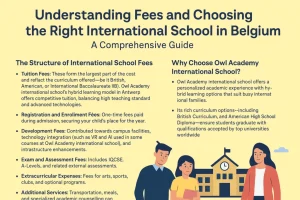
The advertised tuition figure is rarely the final number. Annual fees at international schools in Belgium range from roughly €10,000 to over €35,000 depending on the school tier, curriculum, and year group. Schools in Brussels sit at the top of that range: the British School of Brussels charges between €34,400 and €44,015 depending on year group, while St. John’s International School reaches up to €53,000 at senior secondary level.
Antwerp schools tend to be more competitively priced, with most private international options falling between €17,000 and €30,000, a significant difference worth factoring into your budget planning alongside other relocation costs.
Beyond tuition, the costs that families most often overlook include:
- Capital levy or one-off enrollment fee: €1,500 to €7,000
- School bus transport: €1,800 to €4,000 per year
- Catered lunch: €1,200 to €2,500 per year
- A-Level or AP exam fees in final years: €700 to €2,500
- Uniforms, technology, and school trips: €800 to €3,000 per year
A reliable rule of thumb: the realistic total annual cost runs 15–25% higher than the base tuition figure. If you’re working with employer education allowances (common for EU institution, NATO, or multinational employees), confirm exactly what’s covered before selecting a school. Many allowances cover tuition but not the full extras list, which can create a meaningful gap.
Sibling discounts of 5–10% are available at a number of schools, so ask about this directly if you’re enrolling more than one child.
Your Next Step Starts Now
Enrolling in an international school in Belgium follows a clear sequence: choose a curriculum pathway, assemble your documents, check intake windows early, register with your commune, book school visits, and then apply formally. Working through that order avoids the most common delays families run into when they start at the wrong end of the process.
Starting sooner consistently gives families more options. The most competitive year groups fill months before September, and mid-year places go to families who enquire first.
If you’re based in or around Antwerp and want to understand your options without committing to anything, OWL Academy offers a free initial consultation. Whether or not OWL turns out to be the right fit, speaking with a school early gives you a realistic picture of what the process involves for your specific situation, including which year groups still have space and what your timeline actually looks like.
If you’re targeting a September 2026 start, the time to act is right now. Reach out, book your visit, and get your documents folder ready. At this point in the year, most schools will tell you the same thing: the enquiry you make this week is the one that opens a door in September.