
Choosing the right curriculum is one of the most important decisions parents make when selecting an international school in Belgium. For families moving to Antwerp or already living in the region, the choice often comes down to two popular pathways: the British curriculum and the American curriculum.
Both systems can prepare students for university and international careers, but they differ in structure, assessment, subject specialisation and learning approach. The right choice depends on your child’s academic strengths, interests, preferred learning style and future plans.
At Owl Academy International School in Antwerp, students can choose between a British pathway leading to IGCSE and A Levels, and an American pathway leading to the American High School Diploma with Advanced Placement (AP) opportunities.
What Is the British Curriculum?
The British curriculum is a structured academic pathway that gradually moves students towards subject specialisation.
At Owl Academy, the pathway progresses from the British National Curriculum to IGCSE and then A Levels:
British National Curriculum → IGCSE → A Levels → University
IGCSE is generally studied in Grades 9–10, for students aged around 14–16. Students choose subjects according to their strengths and future plans. Owl Academy offers more than 17 IGCSE subjects through Pearson/Edexcel and Oxford/AQA.
After IGCSE, students can progress to A Levels in Grades 11–12. A Levels provide greater subject depth, with students typically specialising in three or four subjects depending on their programme and goals.
This structure can be particularly suitable for students who already have a strong idea of the subjects they enjoy or the academic area they may want to pursue at university.
What Is the American Curriculum?
The American curriculum generally provides a broader secondary-school education, with students earning credits towards a High School Diploma.
At Owl Academy, the American High School Diploma covers Grades 9–12. Students study a broad range of core subjects, including English, Mathematics, Science, Social Studies and a Modern Foreign Language, alongside elective and advanced options. Progress is based on earned credits and continuous assessment rather than relying primarily on final examinations.
Students can also take Advanced Placement (AP) courses through the College Board. AP courses allow high school students to study college-level subjects and sit AP examinations. Depending on the university, AP results may contribute to admission decisions or university credit, so families should always check the requirements of individual institutions.
The American pathway can therefore suit students who prefer a broader education, continuous assessment and flexibility in choosing subjects.
British vs American Curriculum: The Main Differences
| Feature | British Curriculum | American Curriculum |
| Main secondary qualification | IGCSE and A Levels | American High School Diploma |
| Typical secondary pathway | IGCSE → A Levels | Grades 9–12 Diploma |
| Subject approach | Increasing specialisation | Broader subject range |
| Assessment | Strong examination component | Continuous assessment and credits |
| Advanced study | A Levels | AP courses |
| Best suited to | Students who enjoy subject depth | Students who prefer breadth and flexibility |
| University preparation | Strong academic specialisation | Broad preparation with AP options |
The difference is not simply about which system is “better”. Both can be effective. The more important question is which curriculum fits your child?
Which Curriculum Is Better for a Student Who Loves Academic Specialisation?
If your child already has strong interests in subjects such as Mathematics, Physics, Chemistry, Economics or Computer Science, the British pathway may be worth considering.
The IGCSE stage allows students to build a broad academic foundation while selecting subjects that match their interests. A Levels then provide an opportunity to study selected subjects in considerably greater depth.
For example, a student interested in engineering might choose relevant mathematics and science subjects and then progress to A Levels that support their intended university course.
The British system can therefore work well for students who enjoy structured academic progression and are comfortable preparing for formal examinations.
Which Curriculum Is Better for a Student Who Prefers Flexibility?
The American pathway may appeal to students who prefer to maintain a broader range of subjects throughout secondary school.
Instead of moving into the concentrated subject specialisation associated with A Levels, the American High School Diploma provides a broad programme across several academic areas. Students progress through credits and ongoing evaluation.
This can suit students who enjoy different subjects and do not want to specialise too early.
It can also be attractive to internationally mobile families because the programme provides a four-year high-school structure from Grades 9–12.
How Does Assessment Differ?
Assessment is one of the most noticeable differences between the two pathways.
The British pathway at Owl Academy includes IGCSE and A Level examinations administered through Pearson/Edexcel and Oxford/AQA. Students prepare for formal examination sessions while receiving ongoing academic support throughout the programme.
The American High School Diploma is based on continuous assessment and earned credits. Students demonstrate their understanding through coursework, projects and ongoing evaluation rather than relying solely on high-stakes final examinations.
This distinction matters when considering your child’s learning style.
If your child performs well when working towards major examinations, the British pathway may be comfortable. If your child performs more consistently when their progress is assessed throughout the year, the American pathway may be more suitable.
What About University Admission?
University plans should be one of the biggest factors when choosing between the two curricula.
Both British and American curricula can provide pathways to universities internationally, but individual universities and degree programmes may have specific requirements.
Students following the British pathway may progress from IGCSE to A Levels, while students following the American pathway may complete the High School Diploma and add AP courses where appropriate.
If your child already has a target university or country in mind, research the specific entry requirements before choosing a curriculum.
For example, students considering UK universities should investigate A Level subject requirements for their intended degree. Students considering US universities may want to understand how the institution evaluates the High School Diploma, GPA, AP courses, SAT/ACT requirements where applicable, and other parts of the application.
In other words, university destination should influence curriculum choice, rather than being considered only at the end of school.
What If My Child Is Moving From Another Country?
For families moving to Antwerp with children, the previous school system is another important consideration.
A student already studying within a British-style system may find the transition to IGCSE relatively straightforward. Similarly, a student coming from an American-style school may be more familiar with credit-based progression and continuous assessment.
However, previous curriculum does not automatically determine the right choice. Academic level, age, subjects studied and future plans should also be considered.
Owl Academy provides academic counselling and personalised support to help students and families determine an appropriate pathway.
Which Curriculum Is Right for Your Child?
Before choosing between an American curriculum Belgium pathway and a British pathway, ask the following questions:
Choose the British pathway if your child:
- Enjoys academic depth and subject specialisation.
- Performs well in structured examinations.
- Already has strong subject interests.
- Is considering a pathway involving IGCSE and A Levels.
- Wants to specialise more heavily during the final two years of secondary school.
Consider the American pathway if your child:
- Prefers continuous assessment over major final examinations.
- Enjoys studying a broad range of subjects.
- Benefits from a flexible, credit-based structure.
- Is interested in AP courses.
- May benefit from maintaining broader academic options through Grades 9–12.
Of course, these are general indicators rather than fixed rules. A student’s personality, academic history and individual goals should always be considered.
British or American: Why Not Compare the Student, Not Just the Curriculum?
When comparing international schools in Antwerp, parents sometimes focus too much on which curriculum has the stronger reputation.
A better approach is to ask which system allows your child to perform at their best.
Consider:
Learning style + Academic strengths + Subject interests + Assessment preference + University plans + Previous curriculum
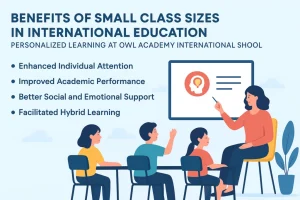
You should also look at class sizes, teaching support, extracurricular opportunities, academic counselling and the school’s approach to university preparation.
At Owl Academy, both pathways are available, allowing families to consider the British and American routes within the same international-school environment. The British route progresses through IGCSE and A Levels, while the American route leads to the High School Diploma with AP opportunities.