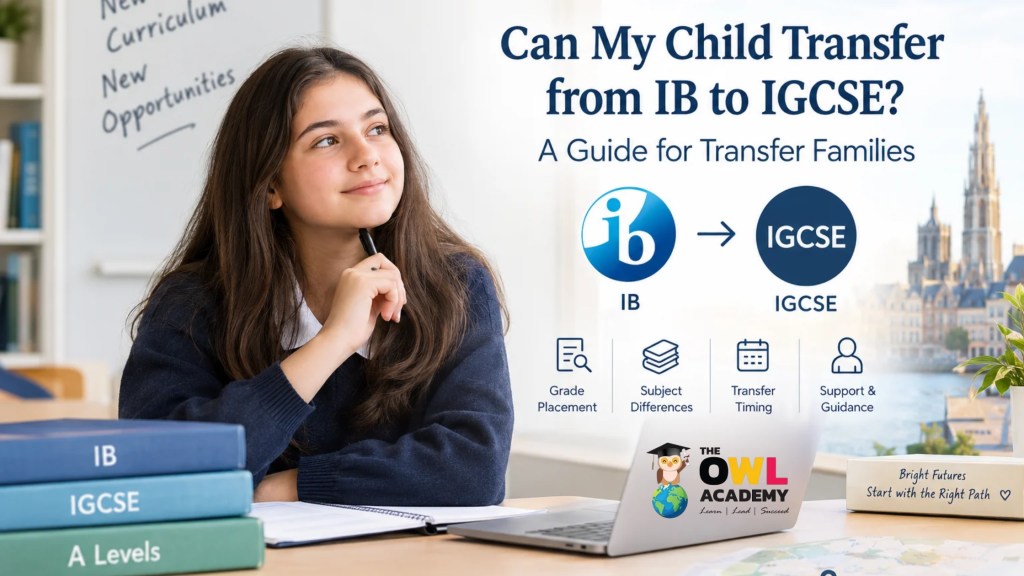
For families moving between countries or changing schools, choosing the right curriculum is an important part of the transition. One common question among transfer families is whether a child can move from the International Baccalaureate (IB) pathway to IGCSE.
The short answer is yes, a child can transfer from IB to IGCSE. However, the transition should be planned carefully because the two programmes have different structures, subject approaches and assessment methods.
Why Do Transfer Families Consider Moving from IB to IGCSE?
Families may consider an IB to IGCSE transfer for several reasons. A family may be relocating to Belgium, moving to a different school, looking for a more subject-focused secondary programme, or planning an academic pathway that leads from IGCSE to A Levels.
For transfer families relocating to Antwerp or other parts of Belgium, understanding how the new curriculum connects with their child’s previous education can make the school-selection process much easier.
The most important factor is not simply whether a student studied IB before. The receiving school needs to understand the student’s current academic level and determine the most suitable placement.
IB and IGCSE: What Is the Difference?
IB and IGCSE are both internationally oriented educational pathways, but they are structured differently.
IGCSE, or International General Certificate of Secondary Education, is typically taken during the secondary years and focuses on individual subjects. Students choose subjects according to their interests and future academic plans.
The IB pathway can refer to different IB programmes, so the comparison depends on the student’s age and the specific IB programme they are studying.
For example, IB Middle Years Programme (MYP) and IGCSE are closer in age range, while the IB Diploma Programme (IBDP) is an upper-secondary programme and is therefore not a direct equivalent of IGCSE.
This distinction is important when planning a curriculum transfer.
Can a Student Move from IB MYP to IGCSE?
Yes. Students completing or transferring from an IB MYP background may be able to move into an IGCSE programme.
The school will normally consider:
- The student’s current grade
- Previous academic results
- Subjects already studied
- English-language proficiency
- The timing of the transfer
- The student’s intended IGCSE subjects
- Future university plans
There is no universal rule that says one IB year automatically equals one specific IGCSE year. Transfer families should therefore speak directly with the prospective school before making a decision.
What About Moving from the IB Diploma to IGCSE?
Moving from the IB Diploma Programme to IGCSE is a different situation.
The IB Diploma is an upper-secondary qualification, while IGCSE is generally completed earlier, around ages 14–16. Therefore, a student already studying the IB Diploma would not normally be moving into IGCSE simply as a like-for-like curriculum transfer.
If a student is considering this type of change, the school would need to review the student’s circumstances individually and recommend the appropriate academic pathway.
How Does the Transfer Process Usually Work?
For transfer families, the process can involve several steps.
1. Review the Student’s Academic Background
The school may request previous report cards, transcripts, subject information and other academic records. This helps the school understand what the student has already covered.
2. Determine the Appropriate Grade
The student’s age does not necessarily determine the correct academic placement on its own. Previous learning and academic readiness are also important.
3. Compare Subjects
IB and IGCSE may cover similar subjects but organise learning differently. A school may therefore identify areas where additional preparation is needed.
4. Select IGCSE Subjects
Students entering the IGCSE pathway normally need to consider which subjects they want to study. These choices can be influenced by strengths, interests and future university or career plans.
5. Consider the Timing
Transferring at the beginning of an academic year can make the transition easier. A transfer close to final examinations may require more careful planning to ensure the student has covered the relevant syllabus.
What If My Child Is Moving to Belgium?
International relocation can make curriculum decisions more complicated because families may be dealing with a new country, language environment, school system and academic expectations at the same time.
For families moving to Antwerp, choosing an international school in Belgium can provide continuity in an internationally oriented environment.
Schools such as Antwerp International School offer the IB pathway, while other international schools provide British or American pathways. Families should compare the curriculum, grade placement, subject choices and long-term academic progression rather than choosing a school based only on its location.
IGCSE at Owl Academy
For families considering a British curriculum after an international-school transfer, Owl Academy International School in Mortsel, Antwerp, offers an IGCSE pathway for students in Grades 9–10, generally ages 14–16.
The programme lasts two years and offers 17+ subject options. Owl Academy provides IGCSE examination pathways through Pearson/Edexcel and Oxford/AQA.
The IGCSE pathway can also lead naturally into A Levels in Grades 11–12, allowing students to continue within the British curriculum.
For transfer families, this can be particularly relevant when planning a longer-term academic pathway rather than making a short-term school change.
Will My Child Need Extra Support?
Possibly. The amount of support needed depends on how closely the student’s previous IB studies match the chosen IGCSE subjects.
A student may need additional preparation if:
- They have not previously studied a particular IGCSE subject.
- They are transferring during an academic year.
- The IGCSE syllabus covers topics they have not yet encountered.
- They are unfamiliar with the examination style.
- They need time to adjust to a more subject-specific curriculum.
A good international school should discuss these factors with the family before confirming enrolment.
Which Is Better: IB or IGCSE?
There is no single answer. The right choice depends on the individual student.
IB may suit students and families who prefer:
- A broad, internationally structured programme
- Interdisciplinary learning
- The IB educational approach
- Continuing through an IB pathway where available
IGCSE may suit students and families who prefer:
- A subject-focused secondary qualification
- A British curriculum pathway
- A clear progression towards A Levels
- Flexibility in selecting individual subjects
The goal should be to choose the pathway that matches the student’s academic needs and future plans.