
Introduction
Moving to a new country often involves making important decisions about your child’s education. For international families relocating to Belgium, one of the first questions is how to determine the appropriate school grade for their child. Understanding grade placement in Belgium can help parents plan school admissions and make the transition to a new education system easier.
School grade placement is not always based on age alone. A child’s previous education, completed subjects, academic progress and the curriculum they followed may also influence the placement decision. This is particularly relevant for families transferring from different educational systems.
For parents exploring an international school in Belgium, understanding the grade placement process can help them prepare the necessary documents and discuss their child’s academic needs with the school.
What Is Grade Placement in Belgium?
Grade placement in Belgium refers to the process of determining the appropriate school grade for a student. The process can vary depending on the school, educational community and curriculum.
Belgium has different education systems across its language communities. International schools may also follow British, American or other international curricula, each with its own grade structure.
When a student transfers from another country, the grade completed previously may not correspond directly to the grade offered by a Belgian or international school. As a result, schools may consider several factors before confirming placement.
For international families, understanding the school’s curriculum and admission requirements is an important first step.
What Factors Determine School Grade Placement?
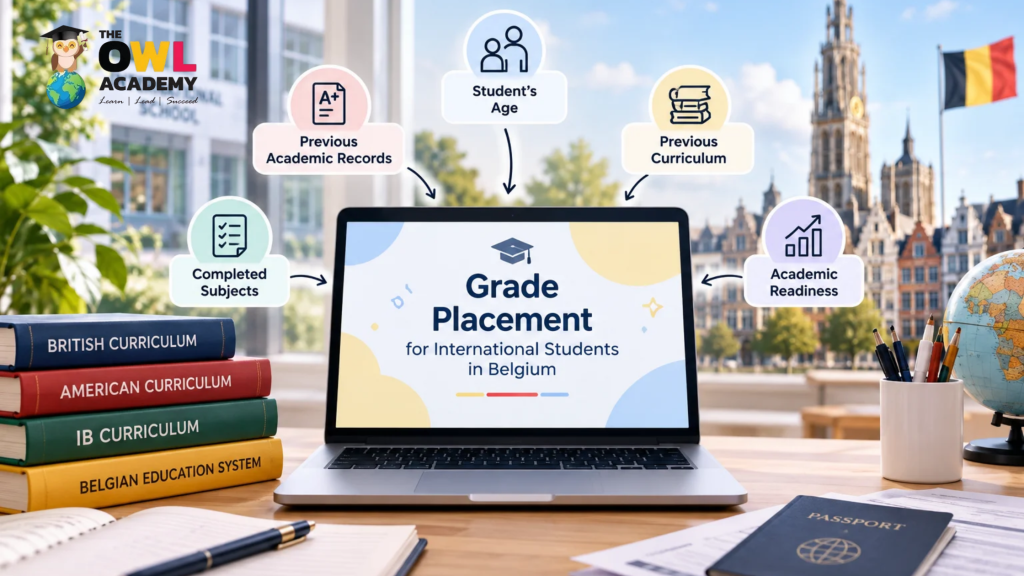
Several factors may influence the grade assigned to an international student. Understanding these factors can help parents prepare for the admissions process.
1. Student’s Age
Age is one of the factors schools consider when determining grade placement. Most educational systems have expected age ranges for different grades.
However, students born in different months may enter school at different ages. International schools may also have their own placement policies.
Parents should confirm the school’s age requirements and discuss any differences between their child’s previous school system and the new curriculum.
2. Previous Academic Records
Previous school records help admissions teams understand a student’s academic progress and educational background.
Schools may review report cards, transcripts and other academic documents to determine which subjects the student has completed and what level of learning they have achieved.
These records can help schools assess whether a student is ready for the academic expectations of a particular grade.
3. Previous Curriculum
Students transferring from British, American, IB or national education systems may have followed different grade structures and subject sequences.
For example, the names and order of grades can differ between educational systems. A student who has completed a particular year in one country may not automatically enter the identically numbered grade in another system.
Understanding the previous curriculum helps schools assess the student’s academic experience and identify a suitable placement.
4. Completed Subjects
The subjects a student has already studied can also influence placement, particularly when moving into secondary education.
Schools may review whether students have covered the expected content in subjects such as English, Mathematics and Science. This is especially relevant when students transfer during a school year or move between different curricula.
5. Academic Readiness
Academic readiness refers to a student’s preparedness for the learning expectations of a particular grade.
Schools may consider previous performance, subject knowledge and other available academic information. Some schools may also use assessments or discussions as part of their admissions process.
The purpose is to understand the student’s educational needs and identify an appropriate learning environment.
How Does Grade Placement Work for International Students?
The grade placement process generally involves several stages. Individual school procedures can differ, so parents should confirm the exact requirements with their chosen school.
1. Initial enquiry
Parents contact the school to discuss their child’s age, current grade, previous curriculum and intended admission date.
2. Submission of academic documents
Parents provide the documents requested by the school, which may include previous school reports, transcripts and identification details.
3. Academic review
The school reviews the student’s previous education, completed subjects and academic progress to understand their educational background.
4. Placement discussion
The school discusses the possible grade placement and any additional requirements with the family.
5. Admission and transition
Once placement and admission requirements are confirmed, the family can prepare for the student’s transition into the new school.
This process helps schools understand the student’s educational background before determining an appropriate grade.
Grade Placement in International Schools in Antwerp
International schools in Antwerp may follow different curricula, so their grade structures and placement procedures can vary.
For example, schools offering the British curriculum generally use year or grade levels that progress towards IGCSE and A Levels. American curriculum schools generally use Grades 9–12 for high school, with a credit-based graduation structure.
Families comparing international schools should consider the following:
- The curriculum and grade structure.
- The student’s previous academic background.
- The subjects offered at the intended grade level.
- The school’s transfer and admission requirements.
- The qualifications available after completing secondary education.
- The support available during the transition.
At Owl Academy in Mortsel, near Antwerp, the British curriculum includes Elementary Grades 1–5, Middle School Grades 6–8, IGCSE Grades 9–10 and A Levels Grades 11–12. The school also offers an American High School Diploma pathway for Grades 9–12.
Parents transferring their children from another educational system can contact the admissions team to discuss their child’s previous schooling and possible placement.
What Documents Should Parents Prepare?
Preparing academic documents before contacting a school can help make the admissions process more organised.
Depending on the school’s requirements, parents may need to provide:
- Previous school report cards or transcripts.
- Records of completed grades and subjects.
- Information about the previous curriculum.
- Student identification documents.
- Any additional academic assessments requested by the school.
For students transferring during the academic year, recent school reports can be particularly useful in explaining their current progress.
Parents should ask the admissions team for a complete list of required documents, as the requirements can differ between schools.
How Can Parents Help Children Adjust to a New Grade?
Changing schools can involve more than adapting to a new academic curriculum. Students may also need time to become familiar with different teaching methods, classroom expectations and social environments.
Parents can support the transition in several ways.
Discuss the change early: Explain the new school’s curriculum, timetable and general learning environment to help your child understand what to expect.
Maintain communication with teachers: Regular communication can help parents understand their child’s academic progress and identify any areas where additional support may be needed.
Encourage independent learning: Help your child develop routines for homework, reading and organising school materials.
Support social adjustment: Encourage participation in classroom activities and opportunities to make new friends.
Allow time to adapt: Every student adjusts at a different pace. Regular encouragement and communication can help children become comfortable in their new environment.
Why Curriculum Continuity Matters for Transfer Students
Curriculum continuity is particularly important for students moving between international schools or relocating from another country.
A student transferring between different curricula may encounter differences in subject content, assessment methods and academic expectations. Understanding these differences can help families prepare for the transition.
For example, students following the British curriculum at Owl Academy can progress from Middle School to IGCSE and then to A Levels. Students following the American pathway work towards the American High School Diploma, with opportunities to take AP courses.
Parents should discuss their child’s previous qualifications and future academic plans with the school to understand the available progression routes.
Why Consider Owl Academy for International Grade Placement?
Owl Academy, located in Mortsel near Antwerp, provides British and American educational pathways for international students.
Its British curriculum includes Elementary, Middle School, IGCSE and A Levels. The American pathway offers the American High School Diploma, with AP course opportunities.
The school follows a personalised approach to education, with small class sizes, subject-specialist teaching and academic support.
For families transferring from another country, discussing previous academic records, completed subjects and curriculum experience with the admissions team can help clarify the available placement options.
Parents interested in international school admissions in Belgium can visit the Owl Academy website to learn more about its programmes and admissions process.
Frequently Asked Questions
1. How is school grade placement determined in Belgium?
Grade placement depends on the education system and school. Factors may include the student’s age, previous academic records, completed subjects, curriculum and academic readiness.
2. Can international students transfer to a different grade in Belgium?
International students can enquire about transferring to a suitable grade. The receiving school’s admissions team reviews the student’s academic background and placement requirements before confirming the appropriate grade.
3. Does age alone determine school placement?
Not necessarily. Age is an important consideration, but schools may also review academic records, previous curriculum and completed subjects.
4. Can students transfer between British and American curricula?
Students can enquire about transferring between these curricula. However, grade equivalency, completed coursework and graduation requirements may differ, so the receiving school needs to review the student’s academic background.
5. What documents are needed for international school admission?
Schools may request previous school reports, transcripts, records of completed subjects and student identification documents. Requirements vary by institution.
6. Can a student transfer in the middle of a school year?
Some schools accept mid-year applications, depending on available places, academic requirements and the student’s circumstances. Parents should contact the school directly to confirm its policy.