
If you’re researching IGCSE in Belgium, you’re probably already familiar with the scenario: sitting at your kitchen table in Antwerp, your 13-year-old finishing homework in the next room, wondering whether the Belgian school system is genuinely the right fit for the next few years. You’ve heard other parents mention IGCSE Belgium options. You’ve Googled it. And now you have twelve browser tabs open and somehow feel less certain than when you started.
That scenario plays out in our office at OWL Academy Belgium every single week. Families across Belgium, from Antwerp and Ghent to Brussels and Mechelen, are asking the same questions. IGCSE is no longer just for British expat families clustered around the EU quarter. It’s a live conversation for ambitious Belgian families, internationally mobile professionals, and students with a specific university destination in mind.
This guide gives you the full picture: what IGCSE actually is, how it stacks up against the Belgian secondary system, which students it genuinely suits, where to find it across the country, and what the 2026 exam calendar looks like. By the end, you’ll have enough to make a confident decision, or at least know which questions to ask next.
What IGCSE in Belgium is (and how it’s structured)
The qualification in plain language
IGCSE stands for International General Certificate of Secondary Education. It’s the internationally designed equivalent of the British GCSE, built specifically for students studying outside the UK. Most students study it over two years, typically between ages 14 and 16 (Years 10 and 11 in the international year-group system), covering a broad mix of academic subjects before moving into A-Levels at post-16 level. Think of it as the foundation layer of a British-style academic track.
The qualification is externally set and externally marked by an international examining body, which means results carry a standardized credential that universities worldwide recognize and verify independently of the school.
Cambridge vs Edexcel: the two exam boards
Two boards offer the IGCSE internationally: Cambridge Assessment International Education (CAIE) and Pearson Edexcel. Cambridge is a widely used option across Belgium’s larger international schools, offering 70-plus subjects and a concept-driven, mixed-assessment model that includes exams, coursework, and practical components. Edexcel IGCSE covers 40-plus subjects and takes a more exam-focused, modular approach, with most assessment through terminal written papers, and is also examined through Oxford/AQA specifications at A-Level.
Both boards are fully recognized for university progression in Belgium and globally. If your child plans to transition to UK A-Levels via the Edexcel and Oxford/AQA route, that alignment with UK specifications can be a real advantage. For students on a more international path, Cambridge’s broader subject range gives greater flexibility, with reach across 160-plus countries.
How grading and tiers work
Cambridge IGCSE uses an A* to G grading scale, with Core and Extended tier options available in most subjects. Extended tier covers more demanding content and is the route for students aiming at top university entry. Grades A* to C are generally considered strong for university applications. Edexcel uses the 9-1 scale aligned with UK GCSEs.
Whichever board your child sits, the tier they’re entered for matters. It affects both the grade ceiling available and how universities read the result.
How IGCSE compares to the Belgian secondary school system
Curriculum structure and subject choice
The Belgian secondary system, whether ASO, TSO, or BSO in the Flemish community or the equivalent French-speaking tracks, follows a fixed national curriculum with limited room for individual customization. Students study a set package of subjects determined by their track and school, not by personal interest or future university plans.
IGCSE takes the opposite approach. Students typically choose between five and ten subjects spanning sciences, humanities, languages, and arts. Academic identity starts forming earlier, and the subject combination can be deliberately shaped around a future degree or career direction. A student targeting Medicine at a UK university can prioritize Biology, Chemistry, and Physics from Year 10 onward, rather than discovering that gap at 17.
Assessment style and what it means in practice
The Belgian system relies heavily on continuous assessment and internally set end-of-year school exams. The quality and difficulty of those assessments varies between schools, and the result is a school report rather than a universally standardized credential.
IGCSE uses externally set, externally marked examinations alongside coursework and practical assessments. The result is verifiable by any university admissions office in the world, independent of which school issued it.
Language of instruction and the real transition
IGCSE is taught in English (occasionally French or Spanish depending on the school). For expat families, this provides direct continuity with a British or international curriculum from a previous country. For Belgian families whose children study primarily in Dutch or French, it’s a full academic immersion in English. That shift isn’t just linguistic, it’s a change in how learning works. IGCSE classrooms tend to be more discussion-based and inquiry-led compared to the teacher-directed model common in Belgian state schools.
Which students genuinely benefit from the IGCSE pathway
Expat and internationally mobile families
For families posted to Belgium for two to five years with EU institutions, NATO, or multinationals, an IGCSE-based pathway provides continuity without disruption. A child who started a British curriculum in London or Singapore can continue that same track in Antwerp without losing academic ground.
IGCSE results transfer seamlessly to international schools globally. Belgian school records, by contrast, require formal equivalency recognition through NARIC-Vlaanderen or the French community’s Service des équivalences. That process takes several weeks and carries no guarantee of acceptance.
Belgian students targeting UK or US universities
A-Levels, which follow directly from IGCSE, are the standard entry route for UK universities including Russell Group institutions. The standard Belgian secondary diploma does not meet the same entry criteria for Oxford, UCL, or Edinburgh. If your child has a UK university in mind, the IGCSE-to-A-Level track is the clearest path.
For students aiming at US colleges, IGCSE-level foundations feed well into an Advanced Placement (AP) track through the College Board, which OWL Academy Belgium offers alongside its British Pearson/Edexcel and Oxford/AQA pathway — one of the very few schools in Belgium providing both under one roof.
Students who learn differently from the Belgian norm
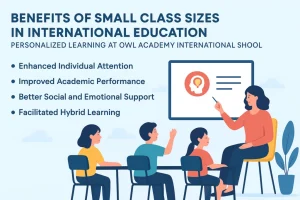
Large class sizes and content-heavy delivery are characteristic of many Belgian secondary schools. Students who are bright but not thriving in that environment often do significantly better in a smaller, more conversational setting. IGCSE classes in boutique schools allow teachers to know each student individually, adjust pace, and develop critical thinking alongside subject knowledge. The academic results, in our experience, tend to follow within one to two terms.
University recognition: what institutions actually accept
Belgian universities and the A-Level requirement
KU Leuven, UGent, VUB, and UCLouvain do accept international qualifications, but IGCSE alone is not sufficient for direct bachelor entry at these institutions. Three A-Levels are the baseline requirement. Subject combinations should be relevant to the chosen programme, and a minimum grade of C applies across the board. STEM and health programmes typically require grades of B or above in Mathematics and a science subject. Families exploring this route should verify requirements directly with the relevant admissions office and work with a school experienced in navigating Belgian admissions processes.
UK, European, and global pathways
In the UK, two or three strong A-Level results meet entry requirements for virtually all universities, including the most competitive ones. Across Europe, universities in the Netherlands, Germany, and Scandinavia also accept A-Levels for direct admission. The qualification travels well.
For US admissions, a strong IGCSE foundation supports later Advanced Placement coursework, and AP results inform both admissions decisions and college scholarship assessments alongside SAT preparation.
IGCSE as the natural foundation for A-Levels
IGCSE is explicitly designed to prepare students for A-Level study. Students who perform at Grade B and above in their chosen subjects are well-positioned for the academic step up. Most schools that offer IGCSE in Belgium also offer A-Levels, so there’s a natural progression without changing schools at 16. This continuity matters for students in the middle of building university applications.
Where to study IGCSE in Belgium: providers by location
Brussels: the largest concentration of schools
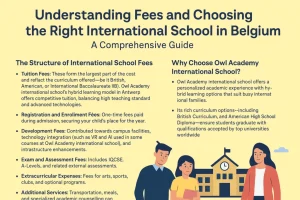
Most of Belgium’s established IGCSE providers are in the Brussels region: the British School of Brussels in Tervuren, British International School of Brussels in Ixelles, ACE of Brussels International School in Auderghem, Brussels International Catholic School in Etterbeek, and others. These are generally full-time institutions with large student bodies. Annual tuition for the IGCSE years typically runs from €22,500 to €31,500, with exam fees, transport, and levies adding a further 15 to 25 percent on top of that base figure. For families based in Antwerp or Flanders, commuting to Brussels for school is simply not practical.
Antwerp and Flanders: a growing but smaller field
Outside Brussels, options in Antwerp include the International School of Belgium in nearby Aartselaar. OWL Academy Belgium, based in Antwerp, is one of the few accredited providers outside Brussels offering IGCSE and A-Levels through Pearson/Edexcel and Oxford/AQA, alongside an Advanced Placement track for students on an American academic path. With intentionally small class sizes, OWL Academy Belgium serves families in Antwerp, Ghent, Mechelen, and the wider Flanders region who want a rigorous international education without the Brussels commute or the large-school environment.
A free consultation is available for families exploring enrolment or a mid-year curriculum switch.
Online and private-candidate options
For students who need flexibility or access to subjects not available locally, online providers are a genuine option. Inventum International Online School offers a dedicated Belgian Package linking students to exam access at ISF Waterloo, which accepts private candidates for both Cambridge and Edexcel exams. Clever Online School and Wolsey Hall Oxford both offer part-time IGCSE subject study for students supplementing another programme. Online study works well as a supplement, but the peer environment and structured mentorship of a full in-person school remain significant at this stage of a student’s development.
2026 IGCSE Belgium exam dates, deadlines, and your enrollment checklist
Key dates for the May/June 2026 Cambridge series
For reference, the Cambridge IGCSE May/June 2026 exam period ran from 23 April to 9 June 2026, that window has now closed. Results for this series release on 18 August 2026. The late entries deadline of 17 April 2026 has also passed, so families who missed this sitting need to plan for the next available opportunity. Subject-specific dates varied across the series: English Language Paper 1 fell on 6 May, Mathematics in late April, and Sciences ran through to early June. Students sit exams over several weeks, not on a single date.
The October/November 2026 series: your next opportunity
The Cambridge October/November 2026 series begins 28 September 2026. The standard entries deadline is estimated at 10 August 2026, with a late entries window closing around 10 October 2026. Results release in late January 2027. This series suits resit candidates or students on an adjusted timeline. Families who missed the June sitting should contact their school or exam officer now about October/November eligibility.
Edexcel runs its own separate calendar: their June 2026 series started 7 May 2026, and their November 2026 series begins 28 September 2026.
What to do next: a practical enrollment checklist
Once you’ve decided which exam board and route is the right move, the steps forward are straightforward:
- Confirm your child’s current year group and the equivalent IGCSE year, typically Year 10 for the start of the two-year course. Note: Year 10 corresponds to the 4th year of Belgian secondary education.
- Decide on exam board preference: Cambridge for a broader, concept-driven approach, or Edexcel and Oxford/AQA for a more structured, exam-focused route aligned to UK A-Levels.
- Research providers by location: in-person in your city, or online if schedule flexibility is the priority.
- Request a school visit or free consultation to assess fit. OWL Academy Belgium offers this for families across the Antwerp and Flanders region.
- Confirm subject choices with the school and verify exam centre registration is in place.
- Mark entry deadlines in your calendar. Missing them means waiting a full year for the next series.
Making the right call for your child
IGCSE in Belgium is a genuinely strong academic route. It is not, however, a universal upgrade over the Belgian system. It’s the right fit for specific students and specific families, and that distinction matters.
A few questions cut through most of the noise. Is your child internationally mobile, and does their academic continuity depend on a globally portable qualification? Do you have a specific university destination in mind that requires A-Levels or an AP-supported US application? Does your child learn better in an English-language, discussion-based environment with more individual attention than a large Belgian secondary school can typically provide?
If the answer to any one of these is yes, the IGCSE pathway deserves serious consideration. For families in Antwerp and across Flanders who want to explore what IGCSE Belgium looks like in practice, OWL Academy Belgium offers a free, no-pressure consultation. It’s the simplest next step, and it starts with a real conversation rather than twelve browser tabs.