
If you are searching for an international school in Antwerp, you have probably noticed that the options look almost identical on the surface. They are all English-medium, they serve roughly the same age range, and they all charge serious tuition. But the curricula, school cultures, fee structures, and long-term university outcomes differ more than their websites suggest. For an expat family arriving in Belgium, or a local family reconsidering its options, making the wrong call here has real consequences for your child’s university trajectory.
This guide gives you a clear, side-by-side picture of every relevant English-medium school in Antwerp, the curriculum pathways each one offers, what families actually pay, and a practical framework for making the decision. What’s available has also changed recently: newer entrants like OWL Academy have expanded the choices open to families in ways that simply didn’t exist two years ago. Here is everything you need to compare your options and take the next step.
How Antwerp’s international school scene breaks down
Three main English-medium schools serve the Antwerp area, though smaller or limited-scope providers do exist in local directories. Knowing these schools’ locations and what each one is built around saves you weeks of research.
Antwerp International School (AIS), located at Veltwijcklaan 180 in Ekeren, is the city’s largest and longest-established option, accepting students from age 2.5 to 18. The International School of Belgium (ISBe) is based in Aartselaar (Kontichsesteenweg 40), a southern suburb, and blends an international early years foundation with Cambridge IGCSE for students aged 3 to 18. Finally, OWL Academy, launched in September 2025 at Sint Benedictusstraat 132 in Mortsel, is Antwerp’s newest school: a boutique, hybrid-learning institution offering British IGCSE and A-Levels through Pearson/Edexcel and Oxford/AQA, alongside Advanced Placement subjects from the College Board for students aged 11 to 18.
For completeness, the Lycée Français International d’Anvers (LFIA) is also in Antwerp, but it follows the French national curriculum rather than an internationally portable one, so it falls outside the scope of this comparison.
Geography matters more than families initially realize. None of these schools are in the city center. For families living in Mortsel, Mechelen, or the Belgian-Dutch border region, OWL Academy’s location in southern Antwerp removes a significant daily commute that attending AIS in Ekeren would otherwise involve.
Curriculum types and what they mean for your child’s future
The curriculum choice is not simply a pedagogical preference. It determines which universities your child can realistically apply to and how competitive that application will be, and the tracks available here lead to meaningfully different admissions processes. Understanding those differences before you visit a single school is the most useful thing you can do at this stage.
British IGCSE and A-Levels: the most direct route to UK universities
IGCSE (ages 14 to 16) feeds directly into A-Levels (ages 16 to 18), and A-Levels remain the standard entry qualification for Russell Group and Oxbridge applications. A-Levels reward depth in three or four subjects, which makes them structurally well suited to specialized UK degree programmes in medicine, law, or engineering.
OWL Academy offers the complete British sequence, IGCSE through A-Levels, delivered through Pearson/Edexcel and Oxford/AQA rather than Cambridge International Examinations (CIE), making it the only international school in Antwerp with this full Edexcel/AQA-based pathway in place. ISBe’s route to A-Level-equivalent credentials runs through Cambridge IGCSE at secondary level.
Advanced Placement and the American track: when US or global flexibility is the goal
For students aiming at US college admissions, or for internationally mobile families who may transfer to an American-system school in a future posting, Advanced Placement (AP) subjects from the College Board — combined with strong SAT scores — build a competitive US application profile.
OWL Academy is the only school in the Antwerp area currently offering this AP-based American pathway, and the only one offering both British and American tracks simultaneously, giving families genuine flexibility if their destination is still uncertain. OWL Academy is a member of Cognia, the US-based accreditation body underpinning its American-curriculum offering.
What it actually costs to attend an international school in Antwerp
The tuition spectrum across Antwerp’s international schools is wider than most families expect when they first start looking.
Annual tuition: the range is wide
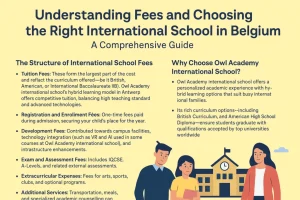
At AIS, annual fees run from €12,800 for a half-day preschool place up to €28,950 for Kindergarten, €35,420 for Grades 6 to 8, and €37,260 for the senior secondary years. ISBe is considerably more accessible: fees start at €9,040 for preschool and reach €19,600 for IGCSE years, with an additional €500 to €1,000 annual capital building fee per child. OWL Academy’s 2026/27 fees sit in the €10,500 to €18,500 range, with Middle School at approximately €14,900 and the A-Level pathway at approximately €17,000 per year.
Hidden costs most families underestimate
The headline tuition figure is never the full story. The additional costs to factor in include:
- Registration fees: one-time fees of €700 to €2,000 at AIS, €750 at ISBe, and a €1,000 non-refundable application fee at OWL Academy
- Transport: annual bus service costs of €1,800 to €3,500 depending on distance
- Meals: catered meals add roughly €1,200 to €2,000 per year
- Trips and activities: extracurricular trips ranging from €300 to €2,500 depending on year group
- Exam fees: A-Level exam fees in final years add another €1,000 to €2,500
For a secondary-age student at AIS, the all-in annual cost can comfortably exceed €40,000 once transport and activities are included. This context matters when comparing a boutique school’s tuition against a large institution’s headline fee: OWL Academy’s total cost of attendance is meaningfully lower than AIS for comparable secondary years, while offering smaller class sizes.
Class sizes and school culture: why boutique often beats big
This is the factor most families underweight during research and later wish they had pressed harder on during school visits.
What the evidence says about secondary class sizes
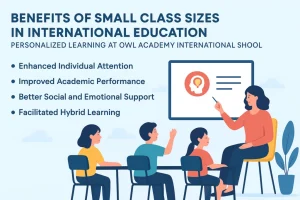
ISBe caps classes at 25 students across all levels. AIS reports a 7:1 student-to-faculty ratio, though specific secondary class caps are not always published. Smaller classes give students who are new to a country, adjusting linguistically, or targeting highly selective university entry direct access to their teacher when it counts most. A student struggling with A-Level Chemistry needs direct teacher access, not a queue.
The case for a boutique dual-curriculum environment
OWL Academy’s small class model is a structural feature built into the school’s design from the outset, not a side effect of a partially filled intake. The dual-curriculum advantage is equally concrete: families do not have to commit to either the British or American track at enrollment because both are available under one roof. This matters most for internationally mobile families who are genuinely unsure whether their next posting will take them closer to a UK or US higher education system.
That combination of small classes, dual pathways, and an Antwerp location outside Brussels is uncommon in the Antwerp area and less common nationally.
How admissions work and what to expect
Most Antwerp international schools follow a broadly similar process, though the details matter.
Documents and steps most schools require
The standard admissions process across these schools involves: an initial inquiry or online application, submission of school reports from the previous two years, proof of English language proficiency for non-native speakers, a placement assessment at secondary level (sometimes including maths and English components), and a school visit or interview. Many schools charge non-refundable registration fees, AIS, ISBe, and OWL Academy all do, so confirm the refund policy before you pay anything.
AIS operates rolling admissions with no fixed annual deadline, which is practical for expat families arriving mid-year; both AIS and ISBe confirm they assess applications year-round.
Mid-year enrollment and what to ask on a school visit
Expat families often need to enroll mid-year, and not all schools facilitate this with equal flexibility. Ask specifically about mid-year availability, EAL (English as an Additional Language) support provisions, and teacher turnover rate. These questions cut through the marketing and surface operational data that school websites rarely publish.
When you visit, go in with a focused list:
- What is the current class size in my child’s specific year group?
- How is the transition structured for students joining mid-year?
- What is the university placement record for students leaving at 18?
How to match the right school to your child’s specific goals
Match the curriculum to the destination first, then let class size and culture guide the final choice. That sequence simplifies what can otherwise feel like an overwhelming decision after weeks of research.
Match the curriculum to the university destination
A few common scenarios cover most families’ situations. If your child is targeting UK universities, prioritize IGCSE and A-Level schools: OWL Academy offers the complete British sequence through Pearson/Edexcel and Oxford/AQA, and ISBe’s Cambridge track covers IGCSE. If the destination is US universities or genuinely uncertain, OWL Academy’s Advanced Placement pathway is the option built specifically for that goal in the Antwerp area. If your child is still in primary years with no fixed destination yet, a broad early-years foundation at AIS or ISBe gives time before committing to a specialist track.
Your concrete next steps
Shortlist two schools based on curriculum fit, then visit both in person before making any financial commitments. On each visit, ask for a full fee breakdown that includes transport, meals, exam fees, and activity costs rather than the headline tuition figure. Ask for current class sizes in your child’s specific year group, not school averages.
OWL Academy offers a free initial consultation for prospective families, check their website to confirm current availability, which gives you the chance to get straightforward answers before committing to anything.
The bottom line on international education in Antwerp
The best international school in Antwerp is not the most expensive or the most established. It is the one whose curriculum aligns with your child’s university goals, whose class size suits the way your child learns, and whose culture fits what your family actually values.
To recap: AIS is a well-established, large-scale option for families who want a long track record and a broad early-years-through-secondary offering. ISBe offers Cambridge IGCSE with a more affordable entry point without sacrificing academic credibility. OWL Academy is the right fit for families who want British qualifications through Pearson/Edexcel and Oxford/AQA or an American AP track, a smaller and more personal environment, and an Antwerp location that does not require a daily trek to Ekeren or a commute to Brussels.
The most useful next step is to visit the schools on your shortlist before the 2026/27 academic year fills up. For families weighing the dual-curriculum boutique route, OWL Academy’s free consultation is a practical, no-pressure place to start that conversation.