A-Levels are among the most demanding academic qualifications a secondary school student can undertake. They require deep subject knowledge, sophisticated analytical thinking, the ability to write at length under pressure, and – perhaps most importantly – the kind of self-directed study habits that most 16-year-olds are still developing.
Every year, students enter A-Level programmes underprepared – not because they lack intelligence, but because neither they nor their parents had a clear picture of what A-Levels actually demand. The result is two years of struggle, disappointing results, and university applications that fall short of what the student could have achieved with the right preparation.
Understanding the genuine indicators of A-Level readiness – and the warning signs that more preparation is needed – is one of the most valuable things a parent can do before their child makes this transition.
What A-Levels Actually Require
It helps to start with a clear-eyed description of what A-Levels demand, because the reality is often different from what students expect.
- Depth, not breadth: A-Level students study three or four subjects intensively over two years. The expectation is genuine mastery – not surface familiarity.
- Independent study: A-Level teaching does not cover everything. Students are expected to read beyond the syllabus, research independently, and engage with their subjects outside of lessons.
- Extended written work: Many A-Level subjects require essays, reports, and extended answers that demand clear argumentation, evidence-based reasoning, and precise use of subject-specific language.
- Examination performance: A-Level results are determined primarily by final examinations – typically three to four hours of written papers per subject, sat at the end of the two-year programme.
- Time management: With multiple demanding subjects and self-directed study required, students who cannot manage their time independently find A-Levels very difficult.
The Signs a Student IS Ready for A-Levels
Strong and Consistent IGCSE Performance
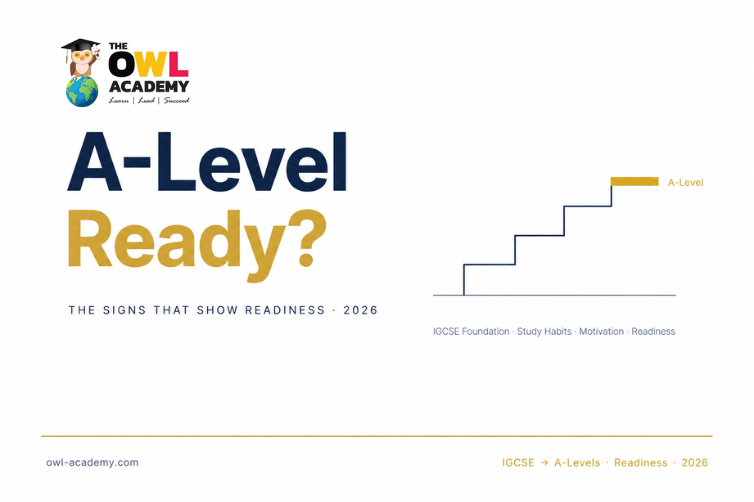
The most reliable indicator of A-Level readiness is a strong IGCSE performance – not just in overall grades, but in the specific subjects the student plans to continue. A student with Grade 7 or above (or equivalent A/A*) in their chosen A-Level subjects has demonstrated both the aptitude and the subject grounding to progress. Consistent performance across the programme – not just a strong final result – is equally important.
Genuine Interest in the Chosen Subjects
Students who are genuinely curious about their chosen A-Level subjects – who read about them beyond what is required, who ask questions that go beyond the syllabus, who find the material interesting rather than just manageable – are far better placed for two years of intensive study than those who have chosen subjects strategically but without real engagement. Intrinsic motivation is one of the strongest predictors of A-Level success.
Independent Study Habits Already in Place
A student who waits to be told exactly what to study, who does not revise without being prompted, and who relies entirely on lesson time for their understanding is not yet operating at the level A-Levels require. Students who already manage their own revision schedules, who seek out additional resources independently, and who take ownership of gaps in their understanding are demonstrating exactly the habits that A-Level study demands.
Ability to Handle Academic Setbacks
A-Levels involve getting things wrong – receiving difficult feedback on essays, achieving lower marks than expected on practice papers, encountering concepts that do not immediately click. Students who respond to setbacks by working harder and seeking help, rather than withdrawing or becoming discouraged, have one of the most important traits for A-Level success.
Clear Direction About University Goals
Students who have thought seriously about what they want to study at university – and who have therefore made subject choices that are genuinely aligned with those goals – are entering A-Levels with a purpose that sustains motivation through the harder periods. This clarity does not need to be absolute, but a student with no sense of direction for their subject choices is at a significant disadvantage.
The Signs a Student May NOT Be Ready
IGCSE Results Below the Threshold for Chosen Subjects
Most serious A-Level programmes require a minimum of Grade 5 or 6 in relevant subjects, with competitive programmes and subjects expecting 7 and above. A student with lower grades in their intended A-Level subjects has not yet demonstrated the academic grounding that those subjects require at advanced level. This is not a permanent barrier – additional preparation, targeted support, or a different subject combination can address it – but it is a clear signal that more work is needed before the A-Level years begin.
Passive Learning Style
Students who learn best when information is delivered to them, who struggle to generate their own questions or drive their own understanding, and who find unstructured study time difficult are likely to find the step up to A-Levels challenging. This is a teachable skill – but it needs to be developed before A-Level study begins, not during it.
Choosing Subjects to Please Others
Students who have chosen A-Level subjects primarily to satisfy parental expectations, teacher recommendations, or a vague idea of what looks impressive – rather than genuine interest or aptitude – frequently struggle to sustain the motivation that two years of intensive study requires. Subject choices made without genuine ownership tend to produce results that reflect that lack of engagement.
Significant Unexplained Gaps in Core Skills
Weak extended writing skills, poor mathematical fluency in STEM subjects, or limited ability to construct a structured argument are warning signs that need to be addressed before A-Level study begins. These foundational skills underpin performance across almost every A-Level subject, and gaps that are not closed at IGCSE level tend to widen under the pressure of advanced study.
How to Bridge the Gap
If a student shows some but not all of the signs of readiness, the period between IGCSE results and the start of A-Levels is one of the most productive times to address specific gaps. Targeted academic support, extended reading in chosen subjects, and focused preparation for the style of thinking A-Levels require can make a significant difference to how a student begins their A-Level programme.
At Owl Academy International School, every student’s transition from IGCSE to A-Levels is supported by personalised academic guidance – ensuring that both students and parents have a clear picture of readiness, and a plan to address anything that needs strengthening before the programme begins.
Final Thoughts
A-Level readiness is not simply about grades. It is about the combination of academic foundation, study habits, subject motivation, and personal resilience that determines whether a student will thrive in the most demanding years of secondary education.
The students who succeed at A-Level are rarely those who found it easy. They are the ones who were genuinely prepared – and who had the right support around them when the work got hard.