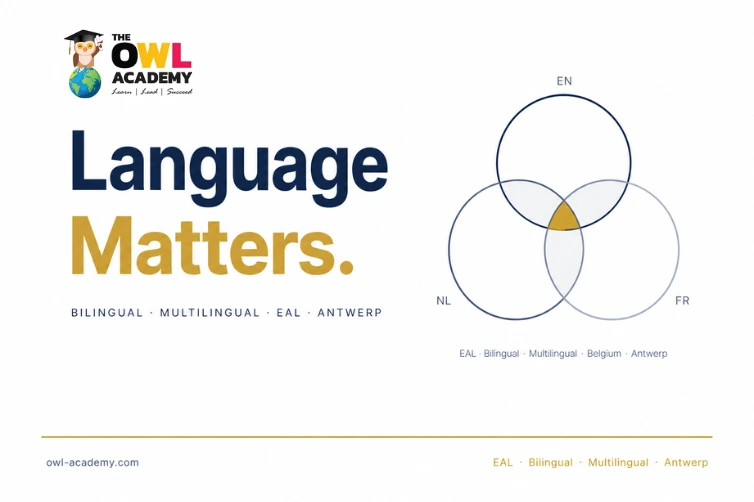
Belgium is one of the most linguistically complex countries in Europe. Three official languages — Dutch, French, and German — divide the country into distinct communities, and the cities, particularly Antwerp and Brussels, are home to dozens of additional languages spoken by the substantial international population that has settled there.
Into this linguistic landscape, international families arrive speaking every combination of languages imaginable: native English speakers, non-native English speakers, bilingual families, multilingual households, and students who have already navigated two or three different school systems in different languages before they reach Belgium.
For each of these families, the school choice question carries a linguistic dimension that most school guides do not address adequately. This article does — and it draws on the experience of Owl Academy International School in Antwerp, which serves students from a wide range of linguistic backgrounds across both the British and American curriculum pathways.
Understanding the Linguistic Profiles of International Students
Before exploring school choice, it helps to identify which category your child falls into — because the needs, and the risks, are different for each.
Native English Speakers
Students who speak English as their first language and who have been educated in English are generally well-placed for international schools in Antwerp that teach in English. The primary considerations are academic — curriculum, qualifications, and university preparation — rather than linguistic. These students will, however, benefit from a school that actively supports language learning beyond English, particularly given Belgium’s multilingual environment.
Proficient Non-Native English Speakers
Students who speak English fluently as a second or third language — but whose family language is not English — are usually able to integrate into English-medium international schools without significant difficulty. The key question is the level of academic English: fluency in conversational English does not automatically translate into the ability to write extended academic essays, engage with complex texts, or perform well in English-medium examinations.
These students benefit enormously from a school that actively monitors academic English development and provides structured support where it is needed.
Students with Limited English Proficiency
Students who arrive in Belgium with limited English and are placed immediately into a full English-medium secondary school without structured support are at serious risk of falling significantly behind — not because of academic weakness, but because the language of instruction is inaccessible to them at their current stage.
For these students, the availability and quality of English as an Additional Language (EAL) support at the school is not a secondary consideration — it is the primary one.
Bilingual and Multilingual Students
Students who move fluidly between two or more languages present their own set of needs. They are often highly adaptable learners — research consistently shows that multilingualism strengthens cognitive flexibility, pattern recognition, and communication skills. But they can also face specific challenges: academic language dominance (being stronger in a subject’s technical vocabulary in one language than another), and the cognitive load of switching between languages in a demanding academic environment.
The Risk of Placing an EAL Student Without Support
It is worth being direct about a risk that many families discover too late: placing a student with limited English proficiency into a full English-medium international school without structured EAL support is one of the most common causes of academic difficulty in the international school sector.
The student may be academically strong. They may have excellent results from their previous school. But if the language of instruction is not yet accessible to them, those academic strengths will not be visible in their new school — and without the right support, the gap between their ability and their performance can widen rather than close.
Before choosing any international school in Antwerp, families in this position should ask directly and specifically. At Owl Academy, new students are assessed on arrival and English language development is monitored as an ongoing part of academic support — not left to chance:
- Does the school have a formal EAL programme — structured language support, not informal teacher assistance?
- How are students assessed on arrival to determine their English proficiency level?
- What is the pathway from EAL support to full mainstream academic participation?
- Are there teachers with specific EAL qualifications, or is language support delivered by subject teachers as a secondary responsibility?
- How long, on average, do students require EAL support before they are fully independent learners in English?
The Advantage of Multilingualism — and How Good Schools Build On It
The cognitive advantages of multilingualism are well documented. Students who speak more than one language at a high level tend to demonstrate stronger executive function, better working memory, and greater ability to switch between tasks and perspectives — skills that are directly relevant to academic performance at IGCSE and A-Level.
Good international schools recognise this and build on it — rather than treating a student’s home language as an obstacle to be overcome. They offer Modern Foreign Language programmes that allow multilingual students to develop additional languages formally, integrate global perspectives into the curriculum, create classroom environments where diverse linguistic and cultural backgrounds are treated as assets, not complications.
For families choosing between schools, ask how the school responds to and builds on linguistic diversity — not just how it manages language barriers.
Language and the Choice of Curriculum
The curriculum your child follows also has a linguistic dimension that is worth considering carefully.
The British curriculum — leading to IGCSE and A-Levels through Pearson Edexcel and Oxford AQA — places significant demands on extended written English, particularly at A-Level. Students writing A-Level essays in English Literature, History, or Economics are expected to produce sophisticated, well-structured academic prose. For a student whose English is still developing at age 16, this represents a real challenge — one that needs to have been addressed during the IGCSE years.
The American High School Diploma, with its credit-based structure and continuous assessment model, can be more forgiving of language development in the earlier grades, allowing students to build English proficiency progressively as they earn credits. AP courses then introduce the more demanding academic language expectations in a structured way as students are ready for them.
Neither pathway is inherently superior for non-native English speakers — but the trajectory is different, and families should understand that difference when making the curriculum choice. At Owl Academy, families receive a personalised pre-enrolment consultation that takes their child’s language background specifically into account when recommending the most appropriate pathway and starting grade.
Practical Advice for Multilingual Families in Antwerp
- Do not assume that conversational English fluency equals academic English readiness — ask the school to assess your child’s academic English specifically before enrolment.
- If your child is still developing English, prioritise EAL programme quality over school reputation or facilities.
- Maintain and develop your child’s home language alongside English — bilingualism is an asset, and the cognitive advantages of maintaining both languages are significant.
- Consider whether the school offers your child’s home language, or another language relevant to your family, as a formal Modern Foreign Language subject.
- Ask about the linguistic diversity of the student body — a school with students from many different linguistic backgrounds is generally better equipped to understand and support multilingual learners.
Final Thoughts
Belgium’s linguistic complexity is not a barrier to a successful international school education — it is, in many ways, an asset. The multilingual environment of Antwerp and Belgium more broadly gives international students an unusually rich context in which to develop language awareness, cultural flexibility, and the communication skills that will serve them throughout their academic and professional lives.
The key for families is to choose a school that understands the linguistic needs of their particular child — not just a school that says it welcomes international students. The difference between the two is real, and it matters enormously. At Owl Academy International School in Antwerp, that understanding begins at the first conversation with the admissions team — and it continues throughout every stage of a student’s time at the school.